|
|
|
SAFEGUARDING CHILDREN AND VULNERABLE ADULTS
The Designated Safeguarding Lead for
The Association of Catholic Nurses England and Wales Janet Muchengwa
email jmuchengwa@yahoo.co.uk
ASSOCIATION OF CATHOLIC NURSES POLICY ON SAFEGUARDING CHILDREN & VULNERABLE ADULTS PRODUCED BY MARY FARNAN IN CONJUNCTION WITH JANET MUCHENGWA FIRST ACCEPTED BY THE EXECUTIVE COMMITTEE OF THE ASSOCIATION OF CATHOLIC NURSES ENGLAND & WALES 14/03/2020 AND SUBMITTED TO THE DICASTERY OF THE LAITY , FAMILY & LIFE , VATICAN CITY . POLICY UPDATED JULY 2026 FOLLOWING REVIEW JUNE 2026
ONLINE SAFEGUARDING TRAINING FOR MEMBERS CAN BE ACCESSED ON THIS LINK OF THE WEBSITE OF THE CATHOLIC SAFEGUARDING STANDARDS AGENCY (CSSA)
CATHOLIC SAFEGUARDING STANDARDS AGENCY
WORKING TOGETHER TO SAFEGUARD CHILDREN UPDATED 2026
PONTIFICAL COMMISSION FOR THE PROTECTION OF MINORS

Dear friends, we received life before we ever desired it. As Pope Francis said: “all of us are sons and daughters, but none of us chose to be born” (Angelus, 1 January 2025). Not only that. As soon as we were born, we needed others in order to live; left to ourselves, we would not have survived. Someone else saved us by caring for us in body and spirit. All of us are alive today thanks to a relationship, a free and freeing relationship of human kindness and mutual care.
That human kindness is sometimes betrayed. As for example, whenever freedom is invoked not to give life, but to take it away, not to help, but to hurt. Yet even in the face of the evil that opposes and takes life, Jesus continues to pray to the Father for us. His prayer acts as a balm for our wounds; it speaks to us of forgiveness and reconciliation. That prayer makes fully meaningful our experience of love for one another as parents, grandparents, sons and daughters. That is what we want to proclaim to the world: we are here in order to be “one” as the Lord wants us to be one, in our families and in those places where we live, work and study. Different, yet one; many, yet one; always, in every situation and at every stage of life.
Dear friends, if we love one another in this way, grounded in Christ, who is the Alpha and the Omega, the beginning and the end (cf. Rev 22:13), we will be a sign of peace for everyone, in society and the world. Let us not forget: families are the cradle of the future of humanity.
HOMILY OF THE HOLY FATHER LEO XIV - JUBILEE OF FAMILIES, CHILDREN, GRANDPARENTS AND THE ELDERLY -01/06/2025
SPEECH OF HIS HOLINESS POPE FRANCIS
TO THE WORLD LEADERS PARTICIPATING IN THE SUMMIT ON CHILDREN'S RIGHTS FEBRUARY 2025
SPEECH OF HIS HOLINESS POPE FRANCIS
ON VIOLENCE AGAINST WOMEN NOVEMBER 2023

Elliott Report :Independent Review of Safeguarding Structures and Arrangements in the Catholic Church in England and Wales
10 November 2020 Independent Inquiry into Child Sexual Abuse :The Roman catholic Church led by Professor Alexis Jay
CATHOLIC BISHOP'S CONFERENCE ENGLAND & WALES SAFEGUARDING IN THE ROMAN CATHOLIC CHURCH
NSPCC
LEARNING DISABILITY AND AUTISM AWARENESS NHS ENGLAND - OLIVER McGOWAN TRAINING
SAFEGUARDING WITH CONFIDENCE - KEEPING CHILDREN AND VULNERABLE ADULTS SAFE IN THE CATHOLIC CHURCH - REPORT BY JULIA CUMBERLEGE FELLOW AND FORMER VICE PRESIDENT OF THE ROYAL COLLEGE OF NURSING -PRODUCED FOR THE BISHOPS' CONFERENCE OF THE CATHOLIC CHURCH
CONGREGATION OF THE DOCTRINE OF FAITH GUIDANCE ON ABUSE AGAINST MINORS
GO TO SECTION FOR MORE ON SAFEGUARDING CHILDREN
GO TO SECTION ON TEENAGE PREGNANCY
GO TO SECTION ON ONLINE ABUSE
GO TO SECTION ON MARRIAGE AND FAMILY LIFE AND SUPPORTING FAMILIES THROUGH FAMILY BREAKDOWN
GO TO SECTION ON DOMESTIC VIOLENCE / ABUSE AND SAFEGUARDING VULNERABLE ADULTS
|
|
|
SECTION ON SAFEGUARDING CHILDREN
SAFEGUARDING CHILDREN - OTHER LEGISLATION AND REPORTS
WAVE TRUST 2024 A DECADE OF TRANSFORMATION - ADVERSE CHILDHOOD EXPERIENCES AND WORKING TO REDUCE CHILD ABUSE, NEGLECT AND WITNESSING DOMESTIC VIOLENCE BY 2030
1001 CRITICAL DAYS - ANDREA LEADSOM ALL PARTY UK DOCUMENT 2014
THE MUNRO REVIEW OF CHILD PROTECTION 2011-FINAL REPORT - A CHILD CENTRED SYSTEM
PHYSICAL PUNISHMENT -IMPROVING CONSISTENCY AND PROTECTION - SINGLETON REPORT 2010 RECOMMENDING AN EXTENSION OF THE BAN ON THE ARGUMENT OF REASONABLE DEFENCE FOR PHYSICAL PUNISHMENT OF CHILDREN
NATIONAL INSTITUTE OF CLINICAL EXCELLENCE (NICE) GUIDELINES DECEMBER 2009 WHEN TO SUSPECT CHILD MALTREATMENT
NSPCC -PROTECTING CHILDREN FROM NEGLECT
|
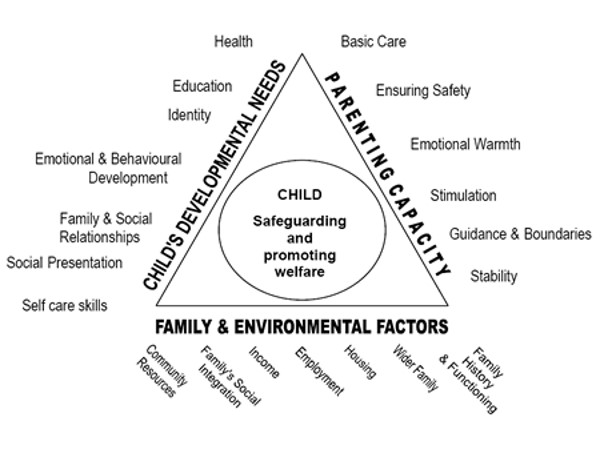
ASSESSMENT FRAMEWORKS
DH ASSESSMENT TRIANGLE
LEVELS OF NEED

THREE HOUSES

|
CHERISHING LIFE
'Child abuse may be physical, sexual, emotional or by neglect. It causes harm that often lasts into adulthood. If the abuser is a parent or if he or she is someone who is supposed to represent God and the Church the harm done can be even greater. Many continue to bear the wounds in their personality, in their close relationships and in their future hopes. Even so, survivors of the various forms of abuse witness to the capacity of the human person to overcome the pain and harm which has been perpetrated. God, who came into the world as a child, can still be found in the process of healing, in those who help in this process and in those who work to protect children ' CLICK HERE FOR FULL TEXT
|
GUIDELINES FOR HANDLING A DISCLOSURE OF ABUSE IN CATHOLIC CHURCH SETTINGS |
|
Do
Take it seriously
Be honest with the child
Be clear that in order to help the child you cannot keep the information to yourself.
Explain to the child what will happen next and reassure that you will support them.
Reassure the child that he or she is right to tell.
Consult and get support.
Write down immediately what the child has said.
Record the time and date and your signature.
Report to the Diocesan Child Protection Co-ordinator and then either you or the Child Protection Co-ordinator must also ensure the incident is reported to the local Social Services or Police Dept . Make sure there is some clear agreement who is to perform the referral to the statutory agencies . |
Don't
Show shock
Try to silence or ask leading questions
Keep the secret
Jump to conclusions
Alert the perpetrator
Make promises you cannot keep.
HOW TO RESPOND
Try to avoid asking what? why? how? when? where? who? are you sure? why didn't you say that before ? or saying 'I can't believe it , I am shocked'.
DO TRY TO REASSURE THE CHILD THAT HE OR SHE WAS RIGHT TO TELL YOU.
|
| |
|
UNITED NATIONS CONVENTION ON THE RIGHTS OF THE CHILD 1989
The State Parties......Recalling that, in the Universal Declaration of Human Rights, the United Nations has proclaimed that childhood is entitled to special care and assistance,
Convinced that the family, as the fundamental group of society and the natural environment for the growth and well-being of all its members and particularly children, should be afforded the necessary protection and assistance so that it can fully assume its responsibilities within the community,
Recognizing that the child, for the full and harmonious development of his or her personality, should grow up in a family environment, in an atmosphere of happiness, love and understanding,
Considering that the child should be fully prepared to live an individual life in society, and brought up in the spirit of the ideals proclaimed in the Charter of the United Nations, and in particular in the spirit of peace, dignity, tolerance, freedom, equality and solidarity....................Recognizing the importance of international co-operation for improving the living conditions of children in every country, in particular in the developing countries,
Have agreed as follows (54 Articles)
ARTICLE 1 For the purposes of the present Convention, a child means every human being below the age of eighteen years unless under the law applicable to the child, majority is attained earlier.
ARTICLE 2 1.. States Parties shall respect and ensure the rights set forth in the present Convention to each child within their jurisdiction without discrimination of any kind, irrespective of the child's or his or her parent's or legal guardian's race, colour, sex, language, religion, political or other opinion, national, ethnic or social origin, property, disability, birth or other status. 2. States Parties shall take all appropriate measures to ensure that the child is protected against all forms of discrimination or punishment on the basis of the status, activities, expressed opinions, or beliefs of the child's parents, legal guardians, or family members.
ARTICLE 3 In all actions concerning children, whether undertaken by public or private social welfare institutions, courts of law, administrative authorities or legislative bodies, the best interests of the child shall be a primary consideration.
UNITED NATIONS - HOW WE PROTECT CHILDREN'S RIGHTS
|
|
|
SECTION ON TEENAGE PREGNANCY
NSPCC PREVENTING CHILD SEXUAL EXPLOITATION
NUFFIELD TRUST 2023 STATISTICS ON TEENAGE PREGNANCY
|
SPUC-TEENAGE PREGNANCIES-WHY WE ARE FAILING
'In order to understand the factors that really contribute to teenage pregnancy, we need to ask: why is it that some youngsters decide to have sex and others don't? For some it may be peer pressure, for others the influence of drink or perhaps just curiosity. One of the biggest factors in the decision is the youngster's attitude to pregnancy. Some teenagers actively want to get pregnant, and providing family planning is unlikely to change anything for this group. Other youngsters are keen to avoid pregnancy. Providing family planning makes these youngsters believe they are less likely to get pregnant and, as a result, more of them are likely to have sex. We are sometimes told, "Young people are going to have sex anyway - nothing will change that". Well, think about the following scenario. Say 100 youngsters have decided to have sex. Now say we were to remove all access to any form of family planning. Would all 100 still decide to have sex? Of course not! Those who want to get pregnant will still have sex. Some of the others will too, perhaps due to ignorance or peer pressure.However,at least some of those who are really keen to avoid pregnancy will now decide to abstain from sex.
The bottom line is that providing family planning in schools is likely to have two effects. Those girls who would have had sex anyway are less likely to get pregnant because they have greater access to contraceptives. However, the number of pregnacies among those girls who start to have sex as a result of providing family planning is likely to increase, because if they weren't having sex at all they wouldn't get pregnant.
We can only judge the overall effect by looking at the evidence. In fact, my research, recently published in the Journal of Health Economics, shows that increasing access to family planning for youngsters simply has not reduced teenage pregnancy rates.2
Many other papers have come to a similar conclusion. In the case of the morning-after pill, a study published in the British Medical Journal found that youngsters who were prescribed the morning -after pill were more likely to go on to have abortions at a later stage.3 Rather worryingly, little or no research has examined the impact of these types of policies on rates of sexually transmitted diseases.
There are two possible ways to interpret the finding that family planning has not reduced teenage pregnancies. One is that access to family planning removes a restraint on those teenagers who would otherwise not engage in sex. The other interpretation is that access to family planning has no effect on youngsters' behaviour at all. Either way, it seems very unlikely that recent proposals to provide condoms and the morning-after pill to youngsters at school without their parents knowing will help in reducing teenage pregnancies.'
click here for the SPUC website |
LIFE PREGNANCY CARE
SEXUAL OFFENCES ACT 2003
|
SECTION ON ONLINE ABUSE
|
SECTION ON THE VALUES OF MARRIAGE AND FAMILY LIFE AND SUPPORTING FAMILIES THROUGH FAMILY BREAKDOWN
'The family in the modern world, as much as and perhaps more than any other institution, has been beset by the many profound and rapid changes that have affected society and culture. Many families are living this situation in fidelity to those values that constitute the foundation of the institution of the family. Others have become uncertain and bewildered over their role or even doubtful and almost unaware of the ultimate meaning and truth of conjugal and family life. Finally, there are others who are hindered by various situations of injustice in the realization of their fundamental rights.
Knowing that marriage and the family constitute one of the most precious of human values, the Church wishes to speak and offer her help to those who are already aware of the value of marriage and the family and seek to live it faithfully, to those who are uncertain and anxious and searching for the truth, and to those who are unjustly impeded from living freely their family lives. Supporting the first, illuminating the second and assisting the others, the Church offers her services to every person who wonders about the destiny of marriage and the family' Familiaris Consortio ,Pope John Paul II,1981.
THE CATHOLIC CHURCH ON DIVORCE
'A child is not something owed to one,but is a gift. The supreme gift of marriage .....If civil divorce remains the only possible way of ensuring certain legal rights, the care of the children, or the protection of inheritance, it can be tolerated and does not constitute a moral offence....... Divorce is a grave offence against the natural law. It claims to break the contract , to which the spouses freely consented, to live with each other till death........... it introduces disorder into the family and society. This disorder brings grave harm to the deserted spouse ,to children traumatized by the separation of their parents and often torn between them.'
Chapman(1994)The Catechism of the Catholic Church ,2378, 2383 -2385
LINKS
|
SECTION ON DOMESTIC VIOLENCE / ABUSE AND SAFEGUARDING VULNERABLE ADULTS
|
CROWN PROSECUTION SERVICE -DOMESTIC ABUSE ACT 2021
children aged 18 and under who witness domestic abuse are now legally recognized as victims of abuse
DOMESTIC ABUSE ACT 2021 - FULL TEXT
DOMESTIC VIOLENCE /ABUSE
WARNING SIGNS OF ABUSE AGAINST WOMEN
Is he jealous and possessive?
Does he cut her off from family and friends and try to isolate her?
Is he charming one minute and abusive the next, does he have sudden changes of mood - like Dr Jekyll and Mr Hyde?
Does he control her life - for example money, who she should see, what she should wear?
Does he monitor her movements?
Does he blame her for the abuse?
Does he humiliate or insult her in front of others?
Does he verbally abuse her?
Does he constantly criticise her?
Does he use anger and intimidation to frighten her and to make her comply with his demands?
Does he tell her she's useless and couldn't cope without him?
Has he threatened to hurt her or people close to her if she leaves?
Does she change her behaviour to avoid making him angry and triggering an attack?
Does he force her to have sex when she doesn’t want to?
THE HOME OFFICE 2010 ON DOMESTIC VIOLENCE working in conjunction with the Dept Health currently states that Domestic violence 'Whether it occurs in public or in private, violence is unacceptable and we are determined to do all we can to prevent it...Domestic violence is any threatening behaviour, violence or abuse between adults who are or have been in a relationship, or between family members. It can affect anybody, regardless of their gender or sexuality.The violence can be psychological, physical, sexual or emotional. It can include honour based violence, female genital mutilation, and forced marriage.' Children witnessing abuse become at risk of becoming emotionally abused themselves and may also become physically abused through exposure to domestic violence sometimes leading to necessary child protection procedures to safeguard them
|
'where social and cultural conditions so easily encourage a father to be less concerned with his family or at any rate less involved in the work of education, efforts must be made to restore socially the conviction that the place and task of the father in and for the family is of unique and irreplaceable importance.(72) As experience teaches, the absence of a father causes psychological and moral imbalance and notable difficulties in family relationships, as does, in contrary circumstances, the oppressive presence of a father, especially where there still prevails the phenomenon of "machismo," or a wrong superiority of male prerogatives which humiliates women and inhibits the development of healthy family relationships' FAMILIARIS CONSORTIO, PART 1 ; 25, Pope John Paul II click here for full text
LINKS
DOMESTIC VIOLENCE
|
|
| |
| |
| |
|
|
|
|
|
|